
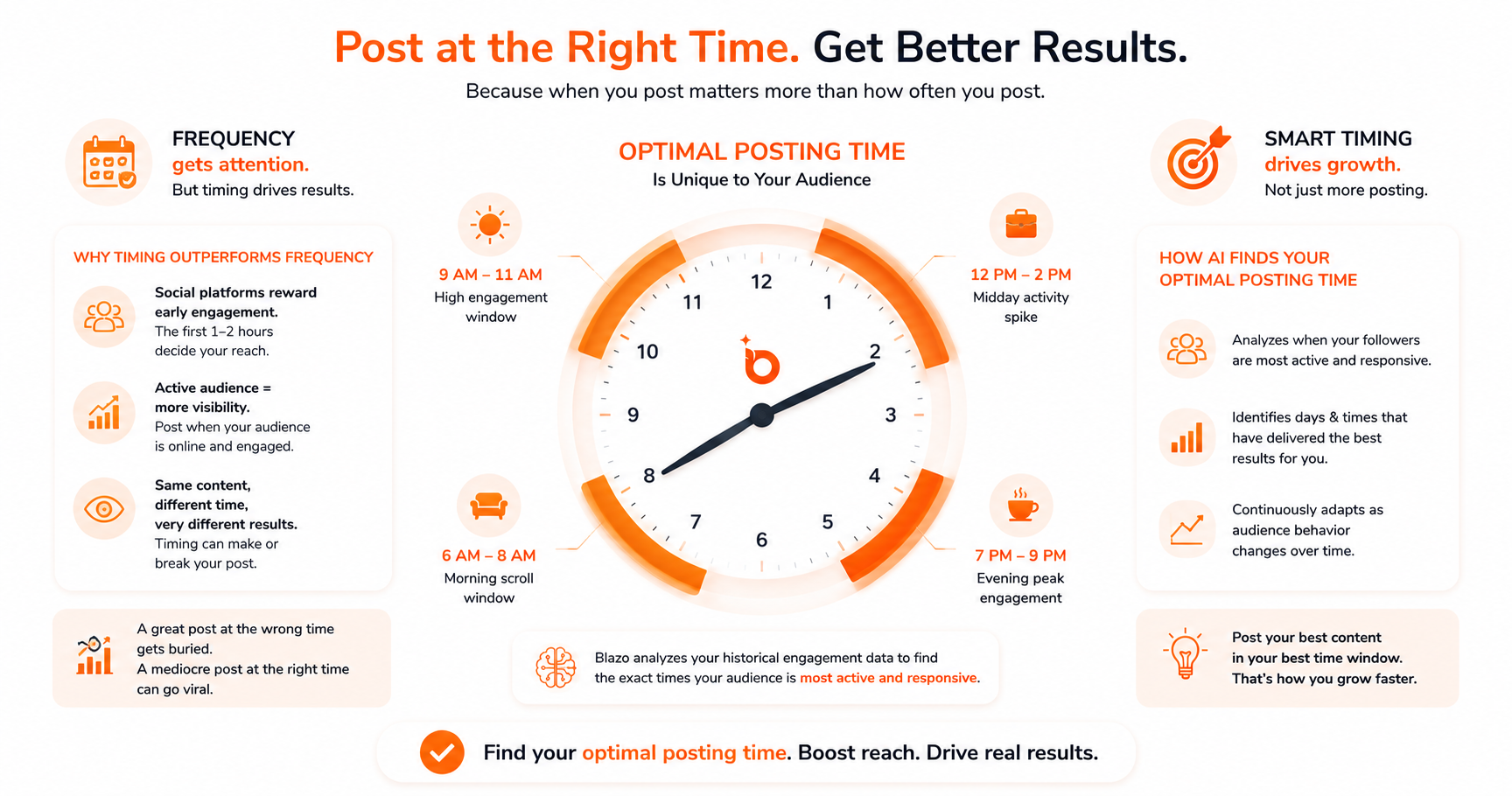
Most advice about social media growth focuses on how often to post — three times a week, daily, twice a day. Far less attention goes to when those posts go out, even though timing can have a bigger impact on reach than frequency does. A great post published when your audience is offline gets buried before anyone sees it. A mediocre post published at the right moment can outperform it.
## Why Timing Outperforms Frequency
Posting frequency assumes every time slot is equally valuable, which isn't true. Social platforms show content to users who are active, and engagement in the first hour or two after a post goes live strongly influences how widely it gets distributed afterward. A post that gets early engagement tends to get shown to more people; a post that goes out into a quiet window often doesn't recover, no matter how good the content is.
This means two businesses posting the same content at different times can get very different results — not because of the content itself, but because one hit their audience while they were active and the other didn't.
## What "Optimal Posting Time" Actually Means
"Optimal" isn't a generic best practice like "post at noon" or "post at 7 p.m." — those numbers vary by audience, industry and platform. A B2B audience on LinkedIn is often most active during work hours on weekdays. A consumer fitness audience might be most active early morning or evening. A restaurant's audience might spike around meal-planning hours.
This is why generic "best time to post" advice is unreliable for any specific business — it's an average across millions of accounts, not a reflection of your actual audience's behavior.
## How AI Determines the Right Time for Your Audience
Platforms like Blazo solve this by analyzing your own historical engagement data rather than relying on industry averages. The process looks at:
- When your specific followers have been most active and responsive in the past
- Which days and times have produced your highest-performing posts historically
- How engagement patterns shift over time, since audience behavior isn't static
Based on that, the platform suggests the exact windows your content is most likely to be seen and engaged with — a number that's specific to your account, not a generic industry benchmark.
## What to Do With This Information
Once you know your optimal windows, the highest-value move isn't necessarily posting more often inside them — it's making sure your best content lands inside them. A weaker post timed well will often outperform a stronger post timed poorly. That's a useful prioritization tool: if you only have one strong piece of content this week, that's the one to schedule in your top engagement window.
## The Bottom Line
Posting frequency gets more attention than posting timing, but timing is often the bigger lever. Before increasing how often you post, it's worth checking whether your current posts are going out when your specific audience is actually paying attention. If they're not, fixing timing first is usually the faster path to better reach.
**Meta description (152 chars):** Posting frequency gets all the attention, but timing often matters more. See why optimal posting time beats posting more often.
**Featured image brief:**
- Concept: A clock face with engagement spikes shown as colored arcs at different hours, highlighting peak windows
- Style: Minimalist data visualization style, single accent color
- Dimensions: 1200x630px
- Alt text: Clock graphic showing optimal posting time windows based on audience engagement
**SEO checklist:** Target keyword "optimal posting time" in H1, intro and one H2. Word count ~680. One bullet list. Single CTA in conclusion.