Most businesses run their marketing on a stack of disconnected tools: one app to schedule posts, another to design graphics, a spreadsheet to track what's working, and a separate dashboard for ad performance. None of them talk to each other, and none of them learn from the others. That's the gap an AI growth OS is built to close.
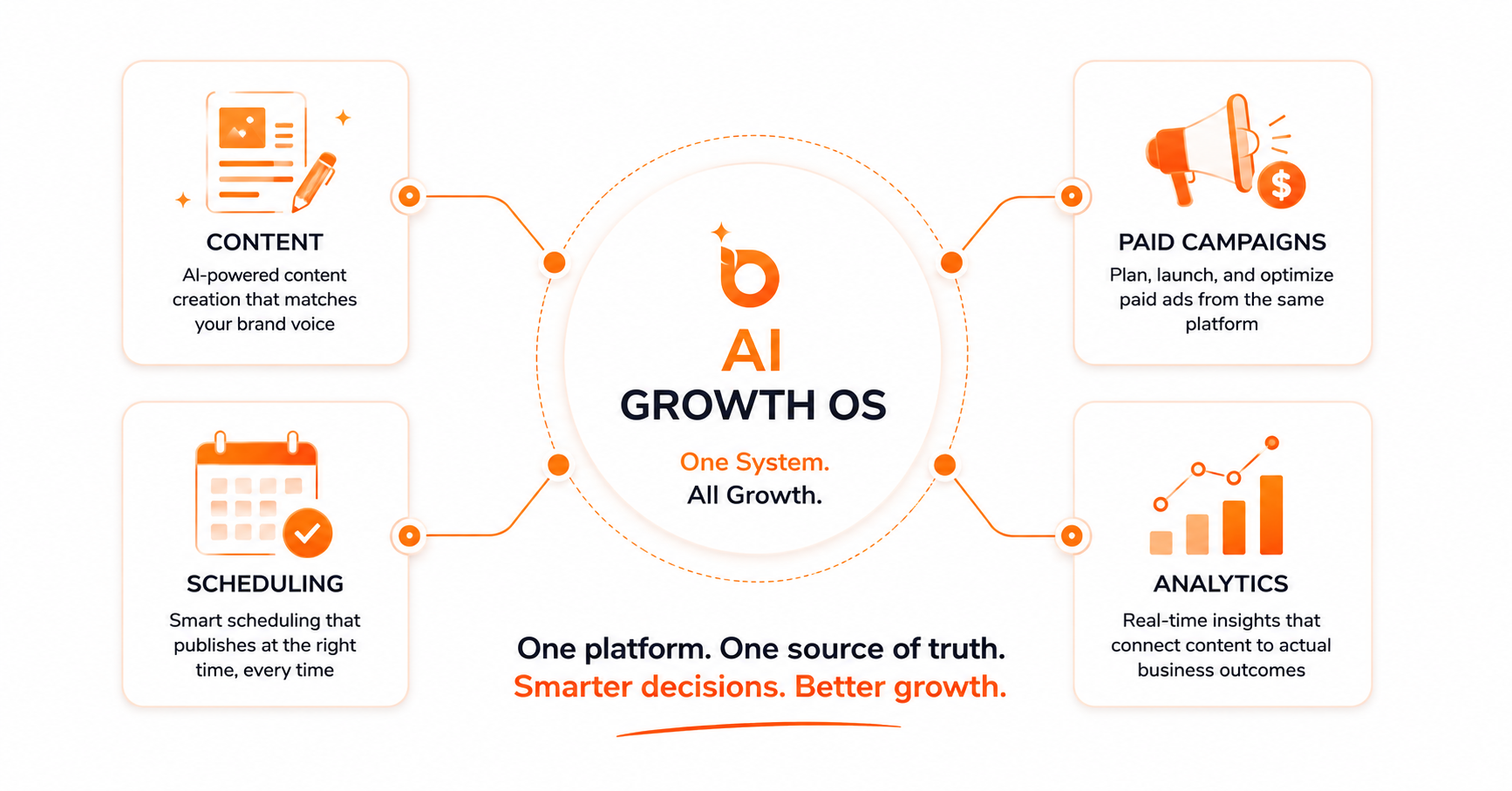
An AI growth OS is a single platform that studies your brand, your audience and your past performance, then uses that information to run your content, your campaigns and your reporting from one place — not as separate features bolted together, but as one system where each part feeds the others.
## How an AI Growth OS Differs From a Scheduling Tool
A scheduling tool answers one question: when should this post go out? An AI growth OS answers a bigger set of questions: what should we post, who should see it, when should it run, how much should we spend, and what should we do differently next week based on what just happened.
The difference shows up in three places:
- **Strategy, not just execution.** A scheduler waits for you to write the caption. A growth OS analyzes your brand voice and your audience's behavior to suggest the caption, the hook and the format before you ask.
- **Closed-loop learning.** Scheduling tools don't know if a post worked. A growth OS tracks engagement, clicks and conversions, then feeds those results back into its next set of recommendations.
- **One system of record.** Instead of checking five dashboards, you check one — content, campaigns, paid ads and analytics live under the same roof.
## Why This Matters for Small and Mid-Size Businesses
Large companies solve the "marketing is fragmented" problem by hiring a strategist, a designer, a media buyer and an analyst. Most small and mid-size businesses can't justify four hires, so the work either doesn't get done or it gets done inconsistently by whoever has time that week.
An AI growth OS like Blazo is built to close that gap without the headcount. It learns a business's brand identity through a process Blazo calls Brand DNA, then operates as a strategist, designer and analyst working continuously in the background — generating content ideas, scheduling them at the right time, running paid campaigns and surfacing growth insights as performance data comes in.
This matters most for businesses in specialized categories — dental practices, law firms, auto dealers, casino operators — where the marketing needs are specific but the in-house marketing resources are thin. A platform that already understands the difference between a service business and a product business, and adapts its strategy accordingly, removes a lot of guesswork.
## What to Look for in an AI Growth OS
If you're evaluating platforms in this category, a few things separate a real growth OS from a glorified content calendar:
1. **Does it learn your specific brand**, or does it generate generic content based on your industry alone?
2. **Does it connect content to outcomes** — follower growth, engagement, revenue — or just track vanity metrics?
3. **Does it manage paid campaigns**, or only organic posting?
4. **Does it get smarter over time**, adjusting its suggestions based on what actually performed?
The platforms that check all four boxes are doing something meaningfully different from a scheduler with a content calendar bolted on.
## The Bottom Line
A scheduling tool helps you publish. An AI growth OS helps you grow — by learning your brand, generating and managing the content and campaigns that fit it, and refining its approach based on real performance data. For businesses without a full marketing team, that difference is the difference between marketing that happens sporadically and marketing that compounds.
If you want to see how this works in practice, Blazo's Brand DNA module is a good place to start — it's the foundation everything else in the platform builds on.
**Meta description (158 chars):** What is an AI growth OS? Learn how it differs from scheduling tools by combining content, campaigns and analytics into one self-improving system.
**Featured image brief:**
- Concept: A single hub icon connecting to four smaller icons (content, calendar, ad campaign, analytics graph), illustrating one system replacing five disconnected tools
- Style: Minimalist flat design, two-color palette on white background
- Dimensions: 1200x630px
- Alt text: Diagram showing an AI growth OS connecting content, scheduling, paid ads and analytics into one platform
**SEO checklist:** Target keyword "AI growth OS" appears in H1, first 100 words, and one H2. Word count ~750. Two lists included. Single CTA in conclusion.
Blazo Blog
Published August 3, 2026