Engagement lift numbers get thrown around a lot in marketing, often without much explanation of where they actually come from. Blazo's platform data shows an average engagement lift of 312% for accounts using the platform's core features. Rather than just stating the number, it's worth breaking down what actually drives a lift like that, because the mechanics matter more than the headline figure.
## What "Engagement Lift" Actually Measures
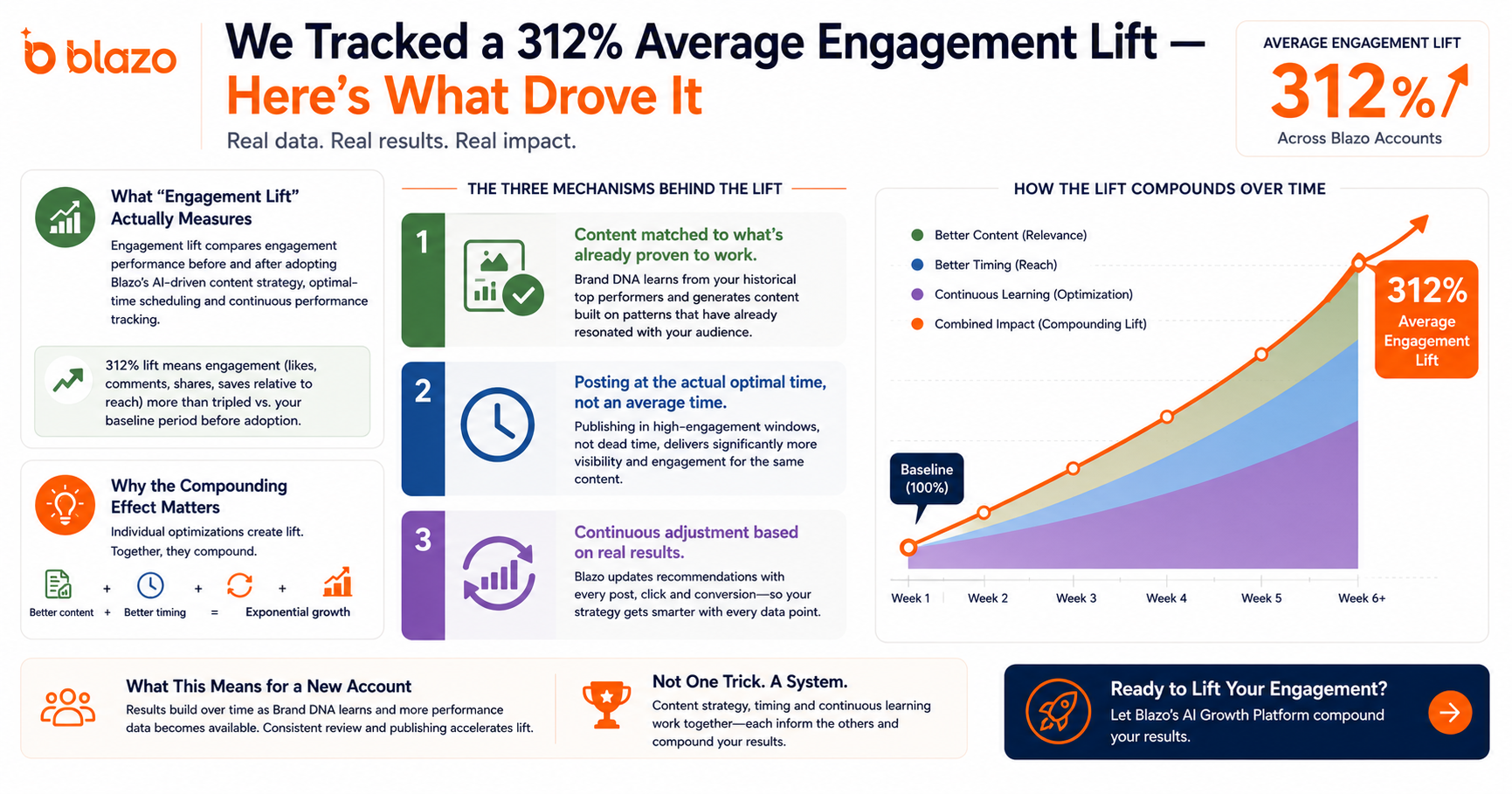
Engagement lift compares engagement performance before and after a specific change — in this case, adopting AI-driven content strategy, optimal-time scheduling and continuous performance tracking. A 312% lift means engagement (likes, comments, shares, saves, relative to reach) on average more than tripled compared to the baseline period before adoption. That's a platform-wide average, which means individual results vary, but the size of the number is large enough to be worth explaining rather than just citing.
## The Three Mechanisms Behind the Lift
A lift this size doesn't come from one feature — it comes from removing several inefficiencies that compound on top of each other.
**1. Content matched to what's already proven to work.** Generic content performs at generic rates. Content generated from Brand DNA — trained on an account's own historical top performers — starts from a stronger baseline because it's built on patterns that have already resonated with that specific audience, rather than guessing.
**2. Posting at the actual optimal time, not an average time.** As covered in our piece on posting time versus frequency, the same content published in a high-engagement window versus a low-engagement window can produce very different results. Part of the lift comes simply from no longer publishing into dead time.
**3. Continuous adjustment based on real results.** Because Blazo's recommendations update with every post, click and conversion, accounts aren't relying on a strategy set once and left alone — the system is incorporating new performance data on an ongoing basis, which tends to compound gains rather than plateau.
## Why the Compounding Effect Matters More Than the Single Number
A single optimization — better timing, for example — might produce a modest lift on its own. The 312% figure reflects what happens when several optimizations run together continuously: better content, better timing and continuous refinement reinforcing each other rather than operating in isolation. This is the practical argument for an integrated platform over a collection of separate point solutions — the lift isn't additive from each piece, it compounds because each piece is informed by the others.
## What This Means for a New Account
For an account just getting started, the 312% figure is a platform average, not a guarantee — early performance depends heavily on how much historical data is available to train Brand DNA and how consistently content gets reviewed and published. Lift tends to build over the first several weeks as the system has more performance data to learn from, rather than appearing immediately on day one.
## The Bottom Line
A 312% average engagement lift isn't a single trick — it's what happens when content strategy, timing and continuous learning operate together instead of separately. Understanding the mechanism behind a performance number is more useful than the number itself, because it tells you what to expect and why, rather than treating the figure as a black box.
**Meta description (157 chars):** What actually drives a 312% average engagement lift? A breakdown of the content, timing and learning mechanisms behind the number.
**Featured image brief:**
- Concept: A growth chart with three labeled contributing layers stacking on top of each other (content, timing, learning)
- Style: Clean data visualization, single accent color line chart
- Dimensions: 1200x630px
- Alt text: Chart breaking down the drivers behind a 312% average engagement lift
**SEO checklist:** Target keyword "engagement lift" in H1, intro and one H2. Word count ~750. Numbered explanation list. Single CTA in conclusion.
Blazo Blog
Published August 3, 2026