
Tourism and hospitality marketing has a timing problem most other industries don't deal with: demand isn't steady, it's seasonal, and the marketing has to ramp up and down in step with it. A campaign that performs well in peak season can fall flat in shoulder season, and a property or destination that markets the same way year-round is leaving bookings on the table during the windows that need the most help.
## Why Seasonality Makes This Industry Harder to Market
Most marketing advice assumes relatively steady demand and optimizes for consistency. Tourism and hospitality businesses instead need to constantly recalibrate: what worked in July doesn't work in November, last-minute deals matter more in shoulder season than peak season, and the audience actively researching a trip three months out looks different from one booking next week.
This creates a real operational challenge — someone has to be thinking about next quarter's campaigns while also running this week's content, and most tourism and hospitality businesses don't have a marketing team large enough to do both well.
## What Seasonal Content Actually Needs to Do
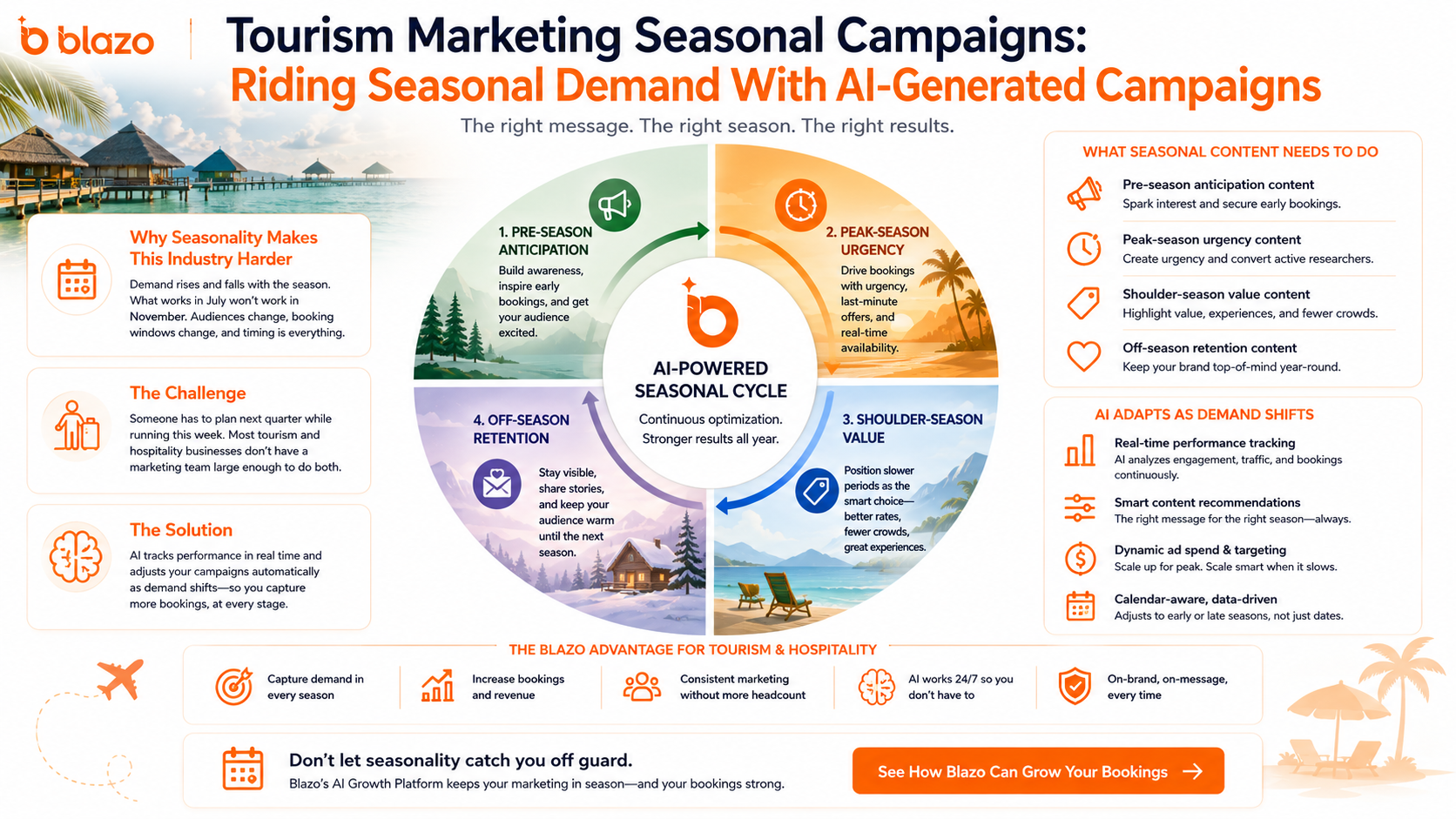
Effective seasonal tourism marketing generally needs to do a few different jobs depending on where in the season it sits:
- **Pre-season anticipation content** — building awareness and early bookings before peak demand hits
- **Peak-season urgency content** — availability, last-minute offers, and content that converts active researchers into bookings
- **Shoulder-season value content** — positioning lower-demand periods as a deliberate choice (fewer crowds, better rates, different experience) rather than a fallback
- **Off-season retention content** — staying visible to past guests and followers even when there's nothing to book right now, so the audience doesn't disengage entirely
Getting this rotation right by hand requires someone tracking the calendar and adjusting strategy every few weeks — work that tends to slip when staff are also handling day-to-day guest operations.
## How AI-Generated Campaigns Handle the Seasonal Shift
An AI growth platform can manage this seasonal rotation more consistently than manual planning typically does, because it's tracking performance data continuously rather than reassessing strategy every few weeks. As engagement and booking-related metrics shift with the season, the platform's recommendations shift with them — surfacing urgency-driven content as peak season approaches and value-driven content as it eases, without someone having to manually flag the transition.
This also applies to paid campaigns: ad spend and targeting can scale up heading into peak demand and pull back during slower periods, based on what the data shows rather than a fixed calendar that doesn't adjust to an unusually early or late season.
## Why Consistency Still Matters in Off-Season
The instinct to go quiet during off-season is understandable — there's less to promote — but it tends to hurt the next season's ramp-up. Audiences who stop hearing from a destination or property for months are more likely to have moved on by the time peak season returns. Lower-frequency, lower-pressure content during off-season keeps the audience warm without requiring the same investment as peak-season campaigns.
## The Bottom Line
Tourism and hospitality marketing isn't just about good content — it's about the right content at the right point in the season. An AI growth platform that tracks performance continuously and adjusts its recommendations as demand shifts can manage that rotation more reliably than a manual calendar, especially for properties and destinations without a dedicated marketing team to track it themselves.
**Meta description (160 chars):** Tourism and hospitality demand shifts by season, and marketing should too. See how AI-generated campaigns adjust automatically as demand changes.
**Featured image brief:**
- Concept: A circular seasonal calendar with four segments (pre-season, peak, shoulder, off-season) each tied to a different content icon
- Style: Warm, inviting flat illustration with a travel-friendly color palette
- Dimensions: 1200x630px
- Alt text: Seasonal tourism marketing campaign cycle adjusted automatically by AI
**SEO checklist:** Target keyword "tourism marketing seasonal campaigns" in H1 variant, intro and one H2. Word count ~770. One bullet list. Single CTA in conclusion.
Blazo Blog
Published August 3, 2026