Ask most business owners how much time they spend on social media each week and you'll get a vague answer — "a few hours, I guess." Track it for a week and the real number is usually much higher: drafting captions, finding or designing images, figuring out when to post, checking what worked, and starting over the next day. That time has a cost, even when nobody's writing a check for it.
## Where the Hours Actually Go
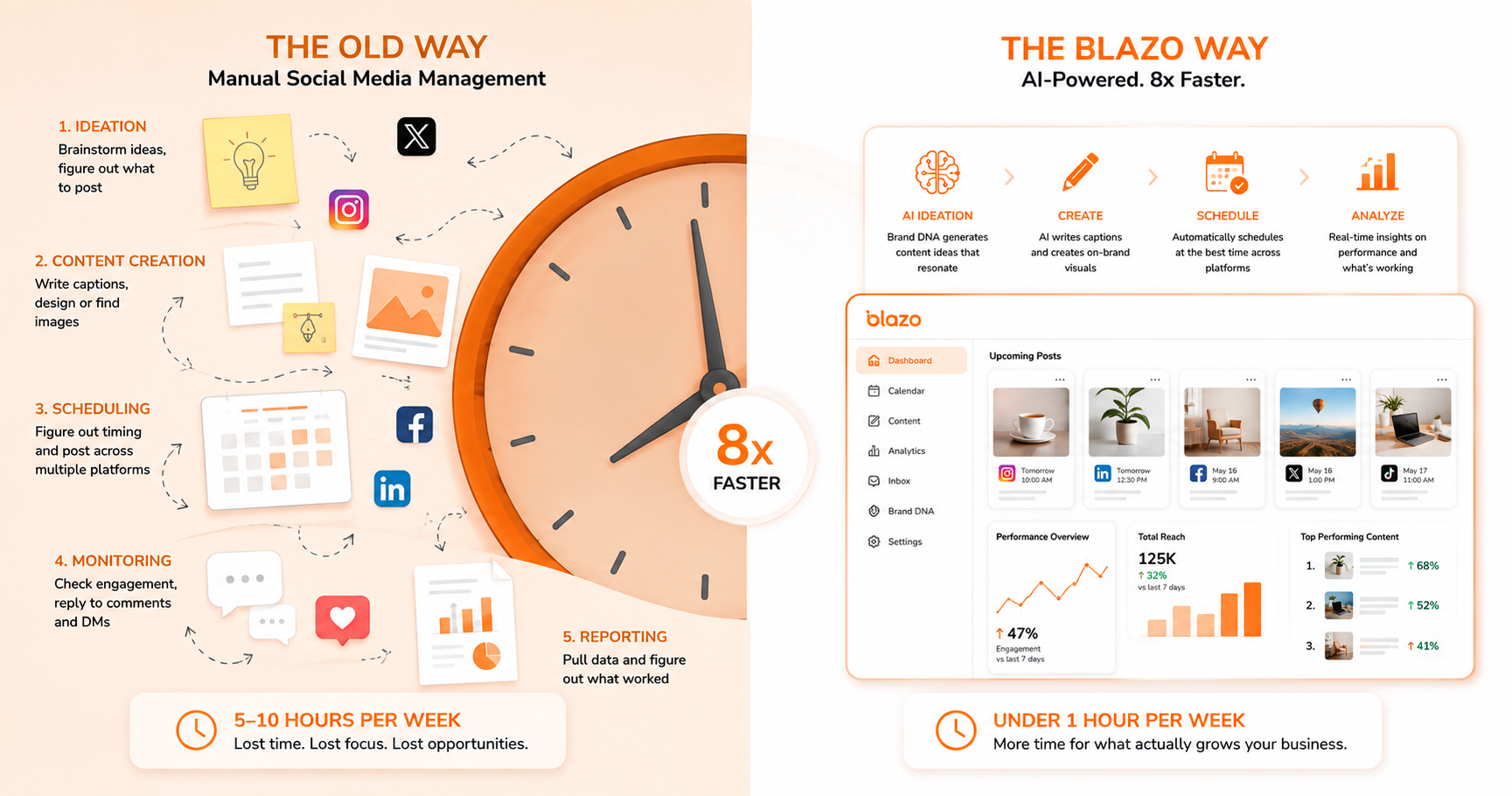
Manual social media management breaks down into five recurring tasks, each of which takes real time every single week:
- **Ideation** — deciding what to post about in the first place, which is often the slowest part
- **Content creation** — writing captions and producing or sourcing visuals
- **Scheduling** — figuring out timing and queuing posts across multiple platforms
- **Monitoring** — checking engagement, replying to comments and DMs
- **Reporting** — pulling numbers together to see what's actually working
For a business posting three to five times a week across two or three platforms, this routinely adds up to five to ten hours — time that isn't going toward running the business.
## Why "Hire Someone" Doesn't Always Solve It
The obvious fix is to hire a social media manager. That works, but it comes with its own costs: salary, onboarding time, and the reality that one person still has to do ideation, design, scheduling, monitoring and reporting largely by hand, just on someone else's payroll instead of yours. The hours don't disappear — they shift.
This is the gap an AI growth platform is built to close. Instead of removing the work from a person's plate by adding another person, it removes the manual portion of the work itself.
## What "8x Faster Content Production" Actually Means
When a platform like Blazo reports content production running roughly eight times faster, that number comes from collapsing the ideation-to-scheduling pipeline into one workflow. Brand DNA generates content ideas based on what's already working for your specific audience. The Creative Studio produces captions and visuals from that idea. The Social Calendar schedules it at the optimal time. What used to be four separate manual steps — each requiring a decision and some amount of trial and error — becomes one reviewed and approved output.
The time savings doesn't come from skipping steps. It comes from the AI doing the first draft of every step, so a person's role shifts from "create from scratch" to "review and approve."
## What This Frees Up
The time saved isn't just about efficiency for its own sake. For a business owner, it's the difference between social media being a recurring distraction and being something that runs in the background. For a business that's been inconsistent with posting — going dark for two weeks, then catching up with a flurry of content — automation tends to fix the consistency problem as a side effect, because the ideation bottleneck that causes the gaps gets removed.
## The Bottom Line
Manual social media management has a real cost, even when it's not on an invoice — it's the hours that don't go toward growing the business. An AI growth platform doesn't eliminate the need for a person to review and approve content, but it removes the slowest parts of the process: deciding what to post, drafting it and figuring out when to schedule it.
If you've never tracked how many hours your team spends on social media in a typical week, that's the first step — it's hard to evaluate the time savings of automation without knowing the baseline you're automating away from.
**Meta description (159 chars):** Manual social media management costs more time than most businesses realize. See where the hours go and how AI content tools cut production time.
**Featured image brief:**
- Concept: A clock split in half — one side showing a cluttered manual workflow (sticky notes, multiple apps), the other showing a single streamlined dashboard
- Style: Flat illustration, contrasting warm/cool color split
- Dimensions: 1200x630px
- Alt text: Comparison of manual social media management time versus automated content production
**SEO checklist:** Target keyword "manual social media management" in H1, intro and one H2. Word count ~700. Two bullet lists. Single CTA in conclusion.
Blazo Blog
Published August 3, 2026