
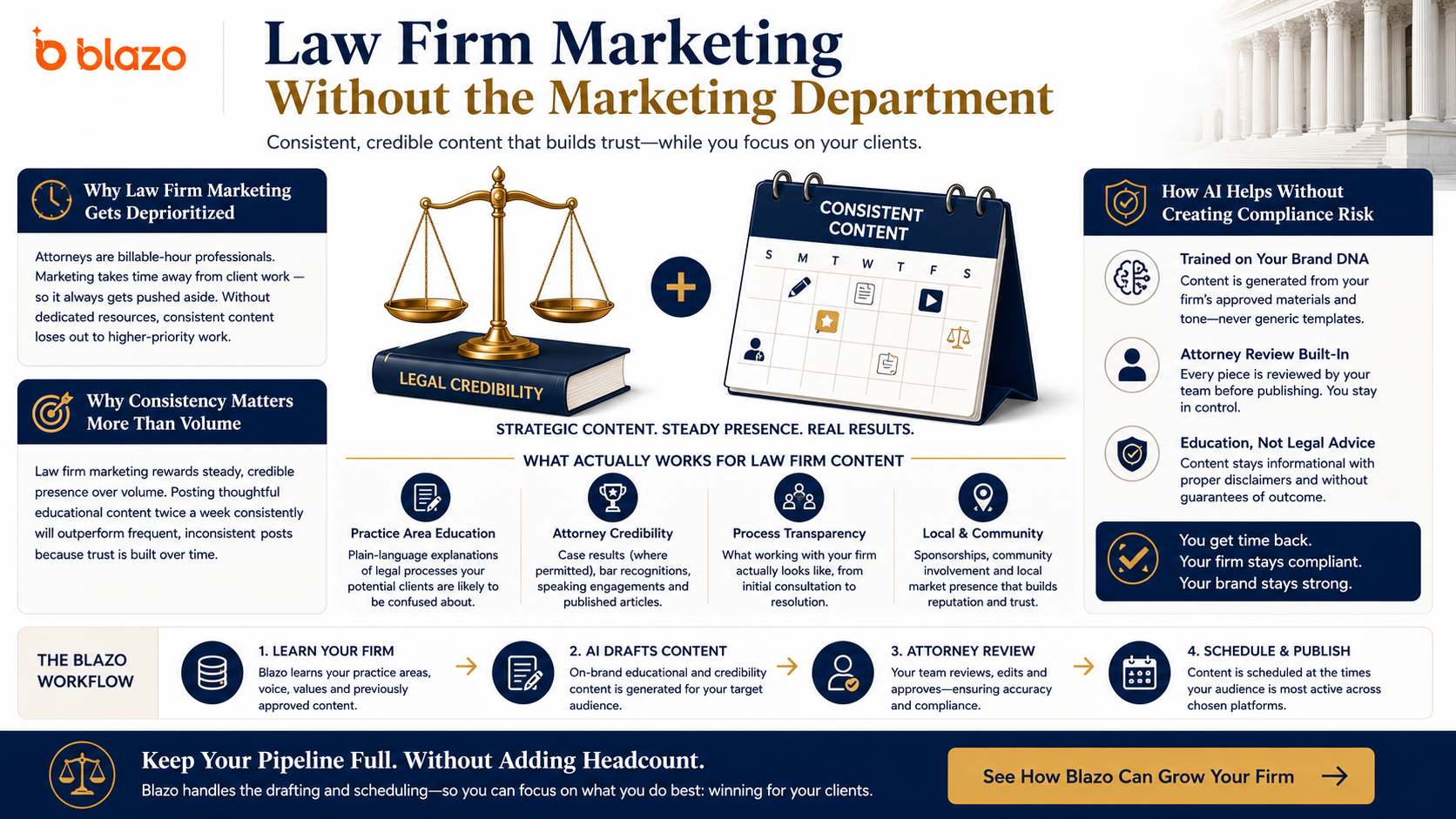
Most law firms, outside of the largest practices, don't have a dedicated marketing department. Marketing usually falls to a partner who has fifteen other priorities, or to an associate who didn't sign up to run social media. The result is predictable: a firm website that hasn't been updated in years and a social presence that's either nonexistent or sporadic.
## Why Law Firm Marketing Gets Deprioritized
Attorneys are billable-hour professionals. Time spent writing a LinkedIn post or planning a content calendar is time not spent on client work, and for most firms, that trade-off resolves in favor of client work every time — even when everyone agrees marketing matters. This isn't a strategy failure; it's a structural one. Without dedicated marketing resources, consistent content simply loses out to higher-priority work.
## What Actually Works for Law Firm Content
Law firm marketing has different constraints than consumer categories — no specific-outcome guarantees, careful handling of client confidentiality, and a tone that needs to read as credible rather than promotional. Within those constraints, a few content types consistently perform well:
- **Practice area education** — plain-language explanations of legal processes a potential client is likely to be confused about (what happens after a car accident claim, how a will gets probated, what to expect in a custody case)
- **Attorney credibility content** — case results (where permitted), bar recognitions, speaking engagements and published articles
- **Process transparency** — what working with the firm actually looks like, from initial consultation to resolution
- **Local and community content** — sponsorships, community involvement and local market presence, which matters disproportionately for firms built on local reputation
## Why Consistency Matters More Than Volume in Legal Marketing
Unlike some consumer categories where high posting frequency drives growth, law firm marketing tends to reward steady, credible presence over volume. A firm posting thoughtful educational content twice a week consistently will generally outperform one posting five times a week inconsistently, because legal services are a high-trust, considered purchase — prospective clients are evaluating credibility over time, not responding to a single viral post.
## How AI Helps Without Creating Compliance Risk
The constraint that makes most attorneys hesitant about AI-generated content is liability: a generic AI tool might produce content that reads as a guarantee of outcome, or that inadvertently implies advice without the appropriate disclaimers. A platform trained on a specific firm's Brand DNA and reviewed by the firm before publishing addresses this differently than a generic AI writing tool would — content is generated based on patterns from the firm's own previously approved material, then routed through attorney review before anything goes out, rather than being auto-published.
This keeps the time savings — content doesn't have to be drafted from a blank page by an attorney or paralegal — while keeping the final compliance and accuracy check where it belongs: with the firm.
## The Bottom Line
Law firms don't need a marketing department to maintain a credible, consistent content presence — they need the drafting bottleneck removed so that what's left is review, not creation. An AI growth platform that generates on-brand educational and credibility content, with attorney review built into the workflow, can keep that pipeline moving without pulling billable attorneys off client work.
**Meta description (159 chars):** Law firms without a marketing department can still maintain consistent, credible content. Here's how AI handles drafting while attorneys handle review.
**Featured image brief:**
- Concept: A scale/gavel icon paired with a content calendar icon, representing legal credibility and consistent content
- Style: Conservative, professional flat design, navy and gold palette
- Dimensions: 1200x630px
- Alt text: Law firm marketing content calendar generated by AI with attorney review
**SEO checklist:** Target keyword "law firm marketing" in H1, intro and one H2. Word count ~770. One bullet list. Single CTA in conclusion.
Blazo Blog
Published August 3, 2026