Most content tools treat each post as a standalone task — write it, schedule it, move to the next one. Blazo's continuous learning loop treats every post as a data point that shapes the next one, which is the difference between a tool that executes and a system that improves.
## What "Continuous Learning" Means in Practice
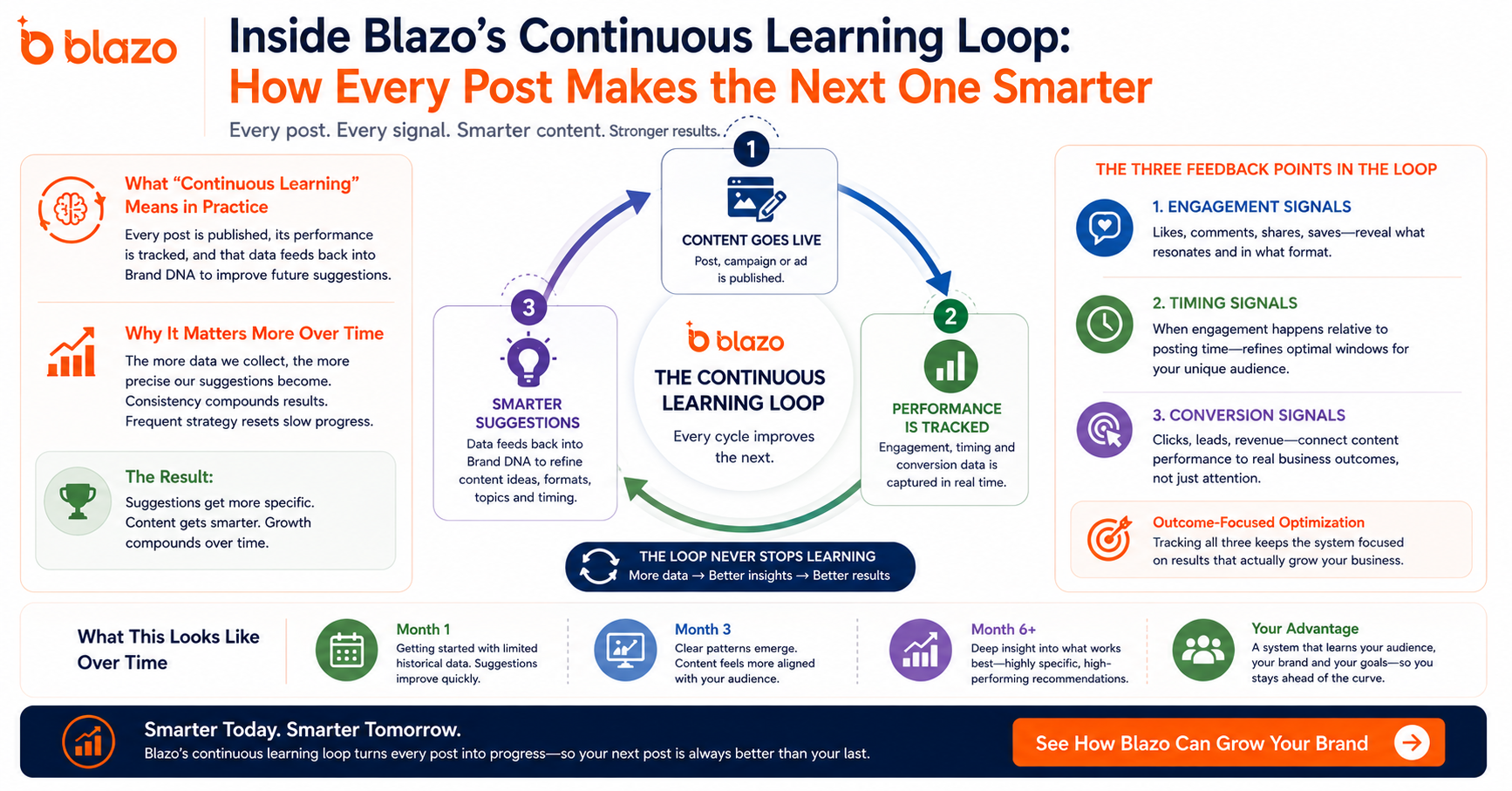
Every time a piece of content goes out through Blazo — a post, a campaign, an ad — three things happen simultaneously: the content gets published, its performance gets tracked, and that performance data feeds back into the Brand DNA model that generates future suggestions. Engagement, clicks and conversions aren't just reported after the fact; they become inputs for what gets suggested next.
This is meaningfully different from a static content calendar built once and followed regardless of results. A static plan doesn't know if last week's post worked. A continuous learning loop does, and adjusts accordingly.
## Why This Matters More Over Time, Not Less
The common assumption is that AI content tools are most useful at the start, when a business has no system at all. In practice, the value compounds the opposite way — early suggestions are based on limited historical data, while suggestions three or six months in are based on a much deeper record of what specifically works for that account's audience. The system isn't just maintaining quality over time; it's actively getting more precise.
This is also why switching content strategies frequently can work against a business using a learning-based platform. Each strategy shift partially resets what the system has learned about what's working, so consistency in approach — even while iterating on specific posts — tends to produce better compounding results than frequent wholesale strategy changes.
## The Three Feedback Points in the Loop
The learning loop draws on three distinct signals, each of which tells the system something different:
- **Engagement signals** (likes, comments, shares, saves) — indicate what content resonates and in what format
- **Timing signals** (when engagement actually happens relative to posting time) — refine the optimal posting windows for that specific audience
- **Conversion signals** (clicks, leads, revenue where tracked) — connect content performance to actual business outcomes, not just attention
A platform that only tracked engagement would optimize for attention alone, which doesn't always correlate with revenue. Tracking all three keeps the loop oriented toward outcomes that actually matter to the business, not just vanity metrics.
## What This Looks Like for a Business Owner
In practice, the learning loop is mostly invisible day to day — a business owner sees content suggestions, schedules and growth insights, not the underlying model retraining itself. What does become visible over time is the trend: suggestions that felt slightly generic in month one tend to feel noticeably more specific to the brand and audience by month three or four, as the system has more of that account's own data to draw from.
## The Bottom Line
The continuous learning loop is what separates an AI growth platform from a static content tool — it's not just generating content once, it's getting more accurate at generating content for a specific brand and audience over time. The longer an account runs through the loop, the more its suggestions reflect that account's actual history rather than general best practices.
**Meta description (160 chars):** Blazo's continuous learning loop uses engagement, timing and conversion data to make every future post smarter than the last. Here's how it works.
**Featured image brief:**
- Concept: A circular feedback loop diagram showing post, performance data and refined suggestion feeding back into each other
- Style: Clean, modern systems-diagram style, single accent color
- Dimensions: 1200x630px
- Alt text: Continuous learning loop showing how post performance data improves future content suggestions
**SEO checklist:** Target keyword "continuous learning loop" in H1, intro and one H2. Word count ~740. One bullet list. Single CTA in conclusion.
Blazo Blog
Published August 3, 2026