
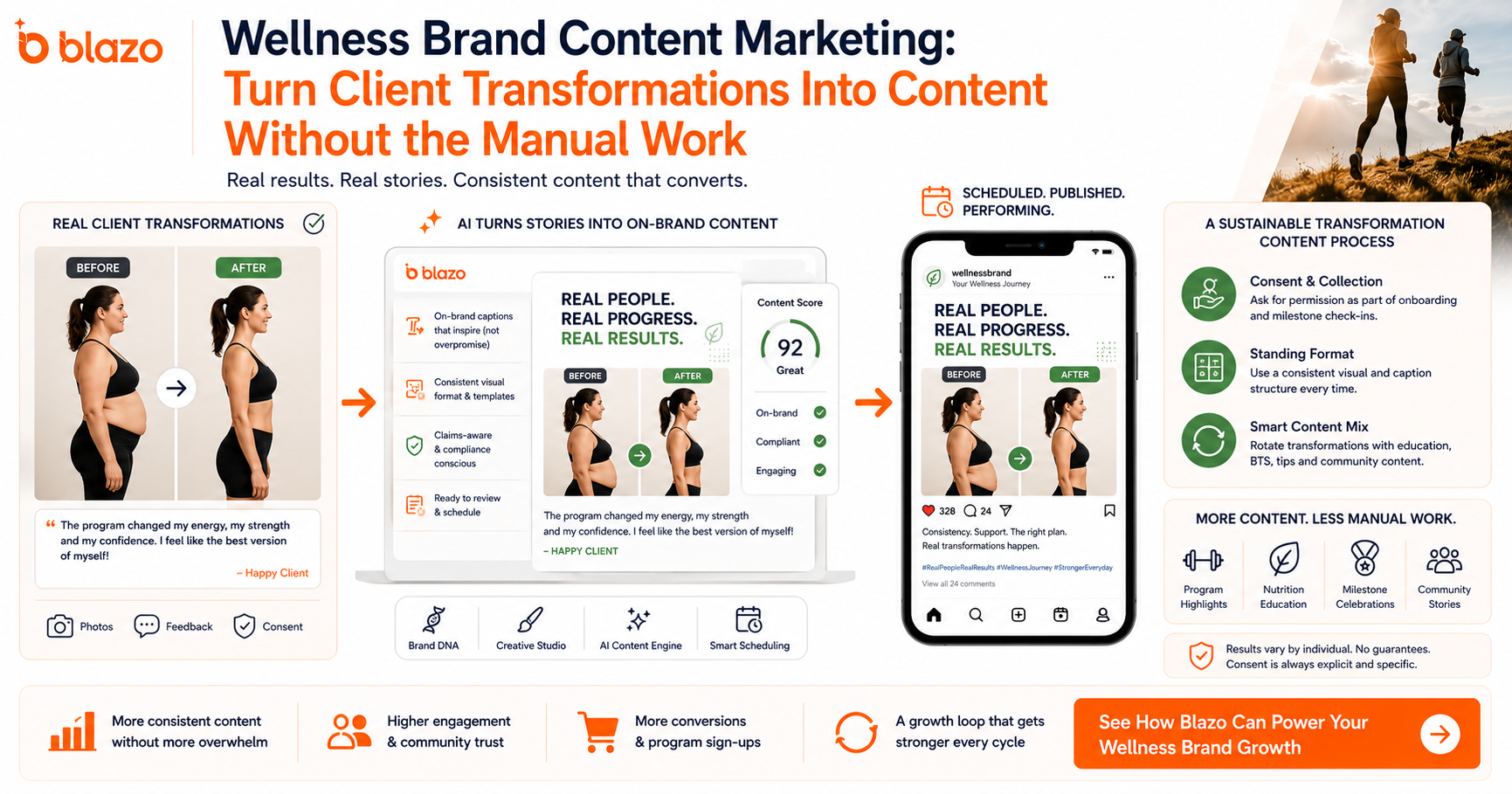
Client transformations are some of the most persuasive content a health and wellness brand can produce — they show, rather than claim, that the service works. They're also some of the most time-consuming content to produce manually, which is why so many wellness brands have a folder full of great before-and-after material that never makes it into an actual content calendar.
## Why Transformation Content Performs So Well
Health and wellness purchases — a gym membership, a nutrition program, a wellness service — are considered purchases. People are skeptical of claims and look for proof before committing. A real client's documented progress is more convincing than almost any other content type a wellness brand can produce, because it answers the prospective client's actual question: does this work for someone like me?
## Why This Content Is Hard to Produce Consistently
The bottleneck isn't usually a shortage of client stories — it's the production process around them. Turning a raw before-and-after photo and a client's verbal feedback into a polished post requires writing a caption that doesn't overpromise, formatting the visual appropriately, getting proper consent, and fitting it into a broader content calendar that isn't only transformation posts. Most wellness brands have this material sitting in a phone's camera roll, not in a content pipeline.
## What a Sustainable Transformation Content Process Looks Like
A workable system generally has three parts:
- **Consent and collection built into the client experience** — asking for permission to share progress as a normal part of onboarding or milestone check-ins, rather than scrambling to request it after the fact
- **A standing content format** — a consistent visual and caption structure so each transformation post doesn't have to be designed from scratch
- **A rotation with other content types** — transformation posts work best as part of a broader mix that includes education, behind-the-scenes and community content, not as the only thing being posted
## How AI Removes the Production Bottleneck
Once consent and raw material exist, an AI growth platform trained on the brand's voice can handle the part that usually stalls — turning a transformation story into a caption and post format that matches the brand's tone, then scheduling it alongside the rest of the content calendar rather than as a one-off. This shifts the staff workload from "produce this post" to "approve this draft," which is a meaningfully smaller lift and far more sustainable to keep up with as new client stories come in.
This same approach extends to other recurring wellness content — workout or program highlights, nutrition education, and client milestone celebrations — all of which benefit from the same treatment: real material that exists but doesn't get turned into content because nobody has time to produce it.
## A Note on Claims and Consent
Transformation content in health and wellness carries real responsibility: results vary by individual, and captions should avoid language that implies guaranteed outcomes. Consent should always be explicit and specific to how the content will be used. These are judgment calls that should stay with brand staff — the AI's role is producing the draft, not making the final call on what gets published.
## The Bottom Line
Wellness brands generally have more transformation material than they're using, not less. The constraint is almost always production time, not proof. An AI growth platform that turns existing client stories into consistent, on-brand content can close that gap, as long as consent and claims review stay in human hands.
**Meta description (159 chars):** Wellness brands often have more client transformation material than they use. Here's how AI content tools close the production gap, not the proof gap.
**Featured image brief:**
- Concept: A before/after split image silhouette transforming into a scheduled content post mockup
- Style: Clean, motivating flat design, energetic but not overly bright color palette
- Dimensions: 1200x630px
- Alt text: Health and wellness client transformation content turned into scheduled social posts
**SEO checklist:** Target keyword "wellness brand content marketing" in H1 variant, intro and one H2. Word count ~780. Two bullet lists. Single CTA in conclusion.
Blazo Blog
Published August 3, 2026