Video has become one of the most important formats for communicating online. Businesses use video for social media posts, paid advertising, product promotions, tutorials, announcements, presentations, websites, and more. But producing high-quality video traditionally requires time, creative resources, editing skills, equipment, and sometimes an entire production team.
AI video generators are changing that process. Instead of starting with a blank editing timeline, you can describe what you want, provide an image or other creative assets, and use artificial intelligence to help transform an idea into a finished video.
Modern AI video tools can support everything from short social media clips to promotional videos, product content, advertisements, educational content, and creative experiments. They can also make it easier to create multiple versions of the same idea for different platforms and audiences.
With BlazoAI, businesses and creators can use AI to turn text and images into engaging video content without relying on a traditional video production workflow for every piece of content.
What Is an AI Video Generator?
An AI video generator is a software tool that uses artificial intelligence to create or assemble video content based on instructions, prompts, images, text, and other inputs.
Instead of manually creating every scene, transition, visual element, and piece of content, the AI can interpret your instructions and help produce a video based on the concept you provide.
For example, imagine you want to create a promotional video for a new product. You could provide a description such as:
"Create a short promotional video introducing a modern wireless speaker. Show the product in a stylish living room, highlight its compact design and premium sound, and finish with a clear call to action."
An AI video generator can use that direction as the creative starting point and generate video content around the concept.
AI video generation can also work from existing images. A product photograph, marketing graphic, property image, or other visual can become the foundation for a video rather than remaining a static asset.
How Does an AI Video Generator Work?
Although the technology behind AI video generation is complex, the user experience can be relatively simple. Most workflows can be understood as a series of steps.
1. Start With an Idea
The process begins with the content you want to create.
Your starting point could be a marketing idea, product description, social media concept, advertisement, announcement, educational topic, or creative brief.
You don't necessarily need a professionally written script. A clear description of the goal, audience, subject, visual style, and desired result can give the AI useful direction.
The more clearly you communicate the intended result, the easier it becomes to generate content that matches your expectations.
2. Provide a Text Prompt or Image
AI video generation can work with different types of input.
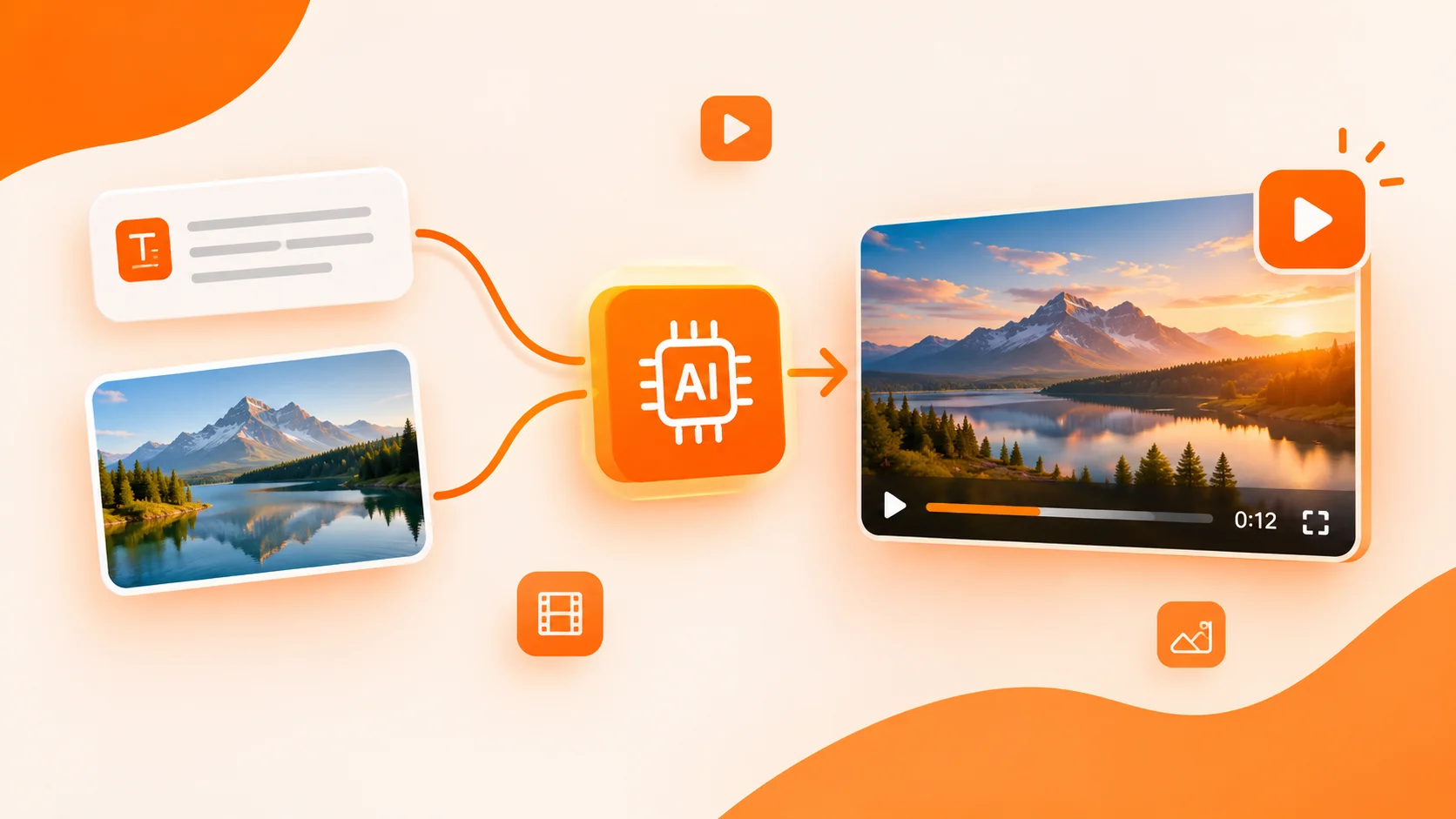
Text-to-video starts with written instructions. You describe the video you want and the AI uses those instructions to develop the visual concept.
Image-to-video starts with an existing image. The AI can use that visual as the foundation for motion and video creation.
This can be especially useful for businesses that already have product photography, promotional graphics, property images, brand visuals, or other creative assets.
3. AI Interprets the Creative Direction
Behind the scenes, AI systems process your instructions and identify important elements such as the subject, environment, visual composition, movement, style, and context.
The system then uses generative models to create visual content that corresponds to the requested concept.
This is one of the biggest differences between AI video generation and traditional editing. Instead of manually building every visual element, the creator can communicate the desired outcome in natural language and let the AI handle much of the initial production work.
4. Scenes and Visuals Are Generated
Depending on the tool and workflow, the AI can generate individual scenes or combine different visual elements into a complete video.
A marketing video, for example, might contain:
- An opening visual designed to capture attention
- A product or service introduction
- Supporting visuals
- Key benefits or selling points
- Text overlays
- Voiceover or audio
- A closing message or call to action
The goal is to transform the original idea into a visual sequence that communicates the message effectively.
5. The Video Can Be Refined
AI generation does not mean that every video has to be accepted exactly as it first appears.
Creative control remains important. You may want to adjust the message, change a visual, modify the pacing, replace an asset, revise text, or create another version.
This is where AI video generation becomes particularly useful for marketing teams. Instead of treating the first generated video as the final product, teams can treat it as a fast creative starting point and continue refining it.
Text-to-Video vs. Image-to-Video
Two of the most useful AI video generation workflows are text-to-video and image-to-video.
What Is Text-to-Video?
Text-to-video allows you to describe a video using natural language and have AI generate visual content based on that description.
For example, a travel company could describe a video showing a relaxing tropical destination. A software company could describe a product demonstration. A restaurant could create a promotional concept around a new menu item.
The major advantage is flexibility. You can begin with an idea rather than needing existing video footage.
What Is Image-to-Video?
Image-to-video starts with a visual asset and uses AI to transform it into video content.
This can be useful for ecommerce businesses, real estate professionals, agencies, creators, restaurants, product companies, and businesses that already have a collection of high-quality images.
Instead of publishing the same static image repeatedly, you can use AI video generation to create a more dynamic presentation of that asset.
Why Are AI Video Generators Becoming Popular?
The growth of short-form video and visual advertising has created a major demand for more creative content. Businesses are expected to produce content consistently across multiple channels, while creative teams often have limited time and resources.
AI video generation can help reduce the amount of manual work involved in getting from an idea to a usable creative asset.
Faster Content Creation
Traditional video production can involve scripting, filming, directing, lighting, editing, sound production, revisions, and exporting.
AI can shorten parts of this process by allowing creators to begin with text or images and quickly produce an initial video concept.
This makes it easier to turn more ideas into actual creative assets.
Create More Content
Marketing increasingly requires a steady stream of fresh creative.
One campaign might require several versions of an advertisement. A social media strategy might require multiple videos every week. A product launch could require different creative for awareness, consideration, retargeting, and conversion.
AI video generation gives teams a practical way to explore more creative concepts without treating every video as a large production project.
Reduce Production Complexity
You don't always need a camera crew, studio, actors, or complicated editing software to create a useful marketing video.
AI video tools can make video production more accessible to marketers, small businesses, entrepreneurs, agencies, and creators who may not have dedicated video production resources.
AI Video Generators for Social Media
Social platforms are highly visual, making video one of the most useful formats for attracting attention and communicating ideas quickly.
Businesses can use AI-generated videos for:
- Instagram Reels
- Facebook content
- TikTok videos
- YouTube content
- Short-form educational videos
- Product demonstrations
- Promotional announcements
- Behind-the-scenes concepts
- Tips and informational content
- Brand storytelling
Platform requirements should still be considered when creating content. For example, Meta's advertising guide provides current information about creative formats and placements, while TikTok's video ad specifications explain requirements for video dimensions, file types, duration, and other advertising details. These official resources are useful references when preparing platform-specific creative.
This is important because creating a video is only one part of the process. The creative should also be prepared for the environment where people will see it.
Using AI Video Generators for Advertising
Advertising is another major use case for AI video generation.
A single campaign may need multiple creative concepts, formats, messages, and variations. Instead of investing heavily in every individual video, marketers can use AI to explore more creative directions.
For example, an ecommerce brand could create videos focused on:
- A product's main benefit
- A specific customer problem
- A product demonstration
- A seasonal promotion
- A customer use case
- A new product announcement
- A limited-time offer
These different concepts can then be adapted for different campaigns and audiences.
AI video generation can therefore become part of a broader creative testing strategy rather than simply being a replacement for traditional video production.
What Can You Create With an AI Video Generator?
AI video generation isn't limited to one type of content. The same technology can support many different creative objectives.
Product Videos
Turn product information and images into engaging promotional videos that showcase features, benefits, and use cases.
Social Media Videos
Create short-form content designed for social platforms, including educational clips, promotional posts, announcements, and creative experiments.
Video Ads
Develop advertising concepts around products, services, offers, or campaigns and create multiple variations for testing.
Educational Content
Turn explanations, tips, tutorials, and informational topics into visual content that can be easier for audiences to consume.
Brand Content
Create videos that communicate your company's identity, products, services, announcements, or ideas.
Real Estate Marketing
Real estate professionals can use property images and descriptions as starting points for promotional video concepts, listing content, and social media posts.
Creative Experiments
AI video generators also make it easier to experiment. You can test visual concepts that might have been too expensive or time-consuming to produce traditionally.
Benefits of Using AI for Video Creation
- Speed: Move from an idea to a video concept much faster.
- Scalability: Produce more creative variations without repeating the entire production process.
- Accessibility: Make video creation available to people without advanced editing skills.
- Flexibility: Start with text, images, or different creative concepts.
- Creative experimentation: Explore ideas before committing significant production resources.
- Marketing efficiency: Create assets for social media, advertising, websites, and other marketing channels.
Are AI-Generated Videos Perfect?
No. AI video generation is powerful, but it is not a substitute for creative judgment.
Generated content can sometimes contain visual inconsistencies, unexpected details, awkward movement, inaccurate representations, or results that don't perfectly match the original concept.
That is why human review remains important.
The best workflow is often a combination of AI speed and human creative direction. AI can help with ideation and production, while people remain responsible for deciding whether the final content communicates the right message and represents the brand appropriately.
Creators should also review generated videos for factual accuracy, brand consistency, licensing considerations, and platform requirements before publishing.
How to Write Better Prompts for AI Video
The quality of the input can have a major effect on the output. You don't need to write a complicated technical prompt, but you should provide enough information for the AI to understand your creative direction.
A useful prompt can describe:
- Subject: What should the video focus on?
- Environment: Where should the scene take place?
- Action: What should happen?
- Style: What visual mood or aesthetic should be used?
- Audience: Who is the video intended for?
- Purpose: Is it educational, promotional, entertaining, or advertising content?
- Format: Where will the video be published?
- Message: What should viewers remember?
For example, instead of simply asking for "a video about coffee," you could provide more context about the product, environment, audience, visual style, and marketing objective.
Specific does not necessarily mean extremely long. The goal is to give the AI useful creative direction without creating unnecessary complexity.
AI Video Creation Should Still Start With a Goal
One of the easiest mistakes is creating a video simply because AI makes it possible.
Before generating content, ask what the video is supposed to accomplish.
Is the goal to introduce a product? Explain an idea? Generate engagement? Drive website traffic? Promote an offer? Build brand awareness? Educate an audience?
Once the objective is clear, the creative direction becomes much easier to define.
This is particularly important for advertising. A visually impressive video isn't automatically an effective advertisement. The viewer should understand what is being promoted and what action they are expected to take.
Why AI Video Generation Is Useful for Modern Marketing
Modern marketing teams need to move quickly. New trends appear constantly, platforms change, audiences respond differently to different creative, and campaigns often require frequent updates.
AI video generation provides another layer of flexibility in that workflow.
Instead of waiting for a complete production cycle before testing a concept, marketers can use AI to explore creative directions earlier. Instead of producing one version, they can experiment with multiple concepts.
This approach also works well alongside existing creative resources. AI-generated video doesn't have to replace photography, professional video shoots, designers, editors, or creative teams. It can become another tool within the creative workflow.
AI Video Generators and Content Quality
Using AI does not automatically make content effective. The quality of the idea, creative direction, editing, messaging, and final review still matters.
This principle also applies to other forms of AI-generated content. Google's guidance on creating helpful content emphasizes quality, usefulness, originality, and a people-first approach rather than using automation primarily to manipulate search rankings.
For businesses, the same principle is useful for video: use AI to create better and more useful content, not simply more content.
What to Look for in an AI Video Generator
If you're evaluating an AI video creation platform, consider how well it fits your actual workflow.
- Text-to-video generation
- Image-to-video generation
- Easy prompt-based creation
- Support for social media content
- Advertising and promotional video workflows
- Creative customization
- Multiple video formats
- Fast generation and iteration
- Simple editing and refinement
- Ability to reuse existing creative assets
- Workflow suitable for marketers and creators
The right platform should make video creation easier rather than introduce another complicated production process.
How BlazoAI Helps With AI Video Creation
BlazoAI brings AI-powered creative tools into a marketing-focused workflow, helping businesses and creators produce content without needing to build every asset from scratch.
With BlazoAI's AI video capabilities, you can start with text or images and turn your ideas into video content for different marketing and creative purposes.
That means the same type of AI-powered workflow can be used for:
- Social media videos
- Product videos
- Marketing videos
- Paid advertising creative
- Promotional content
- Educational videos
- Brand content
- Creative experiments
- Short-form video content
The value isn't simply in generating one video. It is in making it easier to move from idea → creative → variation → campaign asset with less manual production work.
For marketers managing multiple channels, this can help make video a more practical part of the overall content strategy.
The Future of AI Video Generation
AI video technology is continuing to evolve. As generative models improve, video creation is likely to become increasingly accessible and flexible.
We can expect AI video workflows to become more capable of understanding creative instructions, maintaining consistency across scenes, supporting different formats, and helping creators produce content for specific marketing objectives.
At the same time, human creativity will remain important. Businesses still need ideas, positioning, storytelling, brand strategy, and an understanding of their audience.
AI can accelerate production, but the strategy behind the content determines what should actually be created.
Google's guidance on generative AI and Search similarly emphasizes useful, original content and recommends focusing on what users find valuable rather than simply producing content at scale.
Final Thoughts
An AI video generator is a tool that uses artificial intelligence to help transform ideas, text, images, and other creative inputs into video content.
Its biggest advantage is not simply that it can generate video. It can make the process of exploring, producing, and iterating on video content much faster and more accessible.
For social media creators, marketers, advertisers, entrepreneurs, ecommerce brands, agencies, and businesses, that can open up new ways to use video across the customer journey.
The most effective approach is to combine AI generation with a clear creative goal, strong prompts, quality assets, human review, and platform-specific requirements.
With BlazoAI, you can bring that approach into your marketing workflow and use AI to turn text and images into videos for social media, advertising, promotions, and other creative projects.
Have an idea for a video? Start with BlazoAI and turn that idea into creative content.
Frequently Asked Questions About AI Video Generators
What is an AI video generator?
An AI video generator is a software tool that uses artificial intelligence to create or assemble video content from inputs such as text prompts, images, and other creative assets.
Can AI generate videos from text?
Yes. Text-to-video technology allows users to describe a desired video in natural language and generate visual content based on that description.
Can AI turn an image into a video?
Yes. Image-to-video tools can use an existing image as a starting point for creating dynamic video content.
Can AI-generated videos be used for advertising?
Yes. AI-generated videos can be used as creative assets for promotional campaigns and advertisements, provided they meet the requirements of the advertising platform and accurately represent the product or service being promoted.
Can AI video generators create social media content?
Yes. AI video generators can be used to create short-form videos and other creative assets for social media. The final video should be adapted to the platform's current specifications and audience behavior.
Does AI video generation replace video editors?
Not necessarily. AI can automate or accelerate parts of video creation, but human creative direction, editing, quality control, brand judgment, and storytelling can still play an important role.
What is the difference between text-to-video and image-to-video?
Text-to-video starts with written instructions, while image-to-video starts with an existing visual asset. Both approaches can be useful depending on whether you are beginning with an idea or an existing piece of creative.