There's a common assumption that AI growth platforms exist to replace marketing agencies. In practice, the businesses getting the best results are usually using both — but understanding what each one is actually good at is the key to not wasting money on overlap.
## What an Agency Does Well
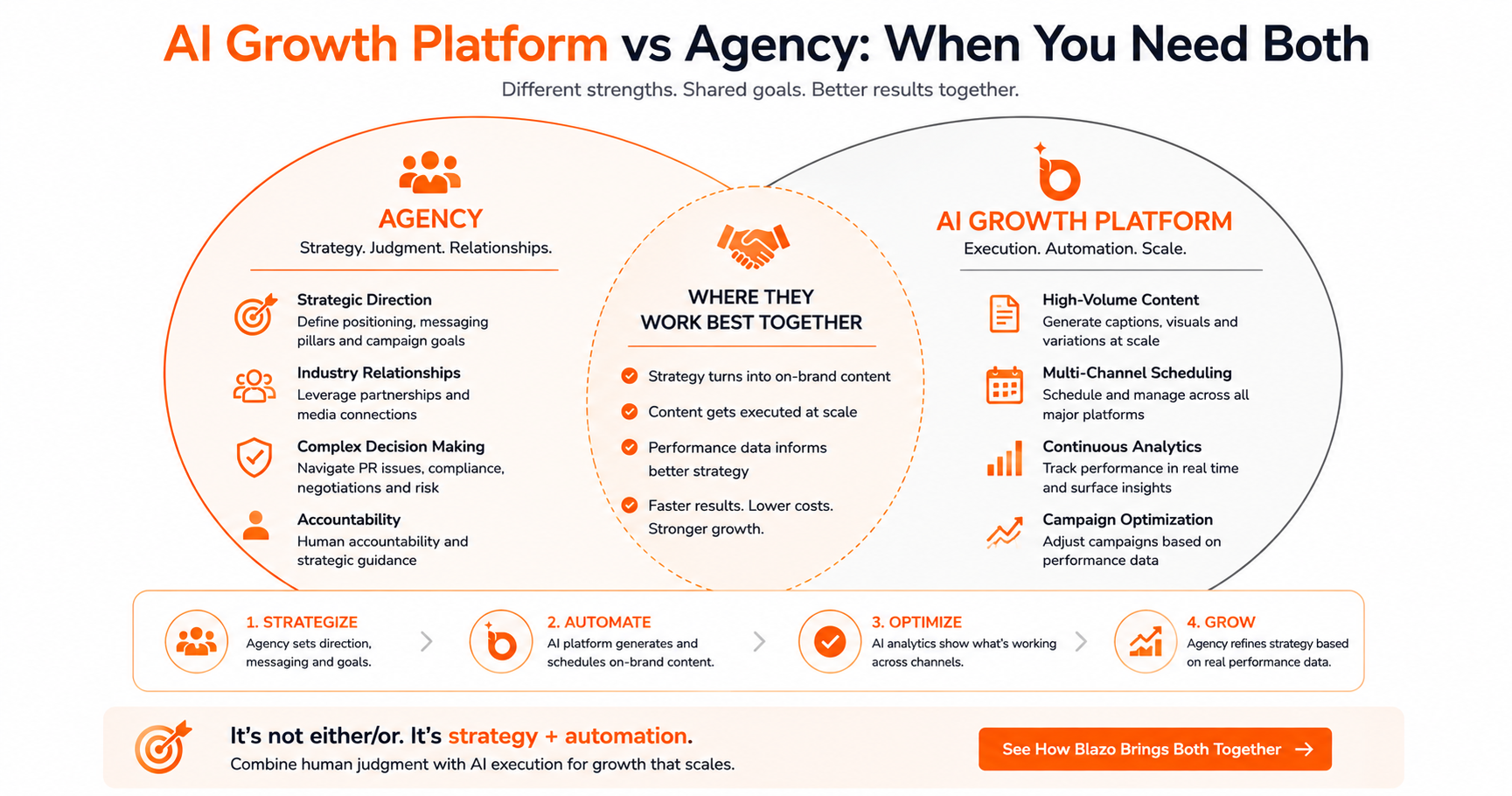
A good agency brings strategic judgment, industry relationships, and the ability to navigate situations that don't have a clean automated answer — a sensitive PR issue, a complex compliance requirement, a negotiation with a media partner. Agencies are also accountable in a way software isn't: there's a person you can call, push back on, and hold to a result.
What agencies are generally not efficient at is the repetitive, high-volume execution work: writing the fortieth caption variation of the month, manually checking analytics dashboards daily, or re-scheduling posts across five platforms one at a time.
## What an AI Growth Platform Does Well
A platform like Blazo is built for exactly the work agencies are inefficient at: high-volume content generation, scheduling across multiple channels, continuous analytics tracking, and campaign management that adjusts based on real-time performance data. It doesn't get tired of producing the fortieth caption variation, and it doesn't need a status meeting to check this week's numbers — that's all surfaced automatically.
What a platform isn't built for is the judgment calls: deciding how to respond to a PR crisis, negotiating a partnership, or making a strategic call on entering a new market. Those require human context the AI doesn't have.
## Where the Combination Works Best
The strongest setup pairs the two: an agency or in-house lead sets the overall strategy and handles judgment-heavy decisions, while the AI platform executes the high-volume content and campaign work the strategy requires. In practice, this often looks like:
- The agency defines positioning, messaging pillars and campaign goals
- The platform's Brand DNA module learns that positioning and generates on-brand content at scale
- The agency reviews and approves rather than creates from scratch
- The platform's analytics surface what's working, which feeds back into the agency's next strategic recommendation
This division of labor tends to reduce agency retainers focused on execution while keeping (or increasing) the strategic value an agency provides.
## When You Might Not Need an Agency at All
Smaller businesses without complex compliance needs, multiple stakeholders, or PR risk often don't need a full agency retainer just to keep content moving. For these businesses, a platform with strong Brand DNA training and built-in analytics can cover the bulk of what an agency's execution team would otherwise be billing hourly to do — leaving the agency relationship, if any, focused on occasional strategic check-ins rather than day-to-day output.
## The Bottom Line
The agency-vs-platform framing is usually the wrong question. The better question is which parts of your marketing require human judgment and relationships, and which parts are repetitive execution that an AI system can run continuously without losing quality. Most businesses land somewhere in the middle — and the ones getting the most out of both are the ones who've drawn that line clearly instead of treating it as an either-or decision.
**Meta description (157 chars):** Agencies and AI growth platforms aren't competitors — they solve different problems. Here's how to combine both without paying for overlap.
**Featured image brief:**
- Concept: A venn diagram with "Agency" and "AI Platform" circles overlapping, labeled with strategy/judgment on one side and execution/automation on the other
- Style: Clean diagram style, two-color contrast
- Dimensions: 1200x630px
- Alt text: Venn diagram comparing agency strategy work with AI growth platform execution
**SEO checklist:** Target keyword "AI growth platform vs agency" in H1 variant, intro and one H2. Word count ~720. One bullet list. Single CTA in conclusion.
Blazo Blog
Published August 3, 2026